lamdha books -
Catalogue of books on the art of conjury

Click on the small images at right to see a larger picture

74755
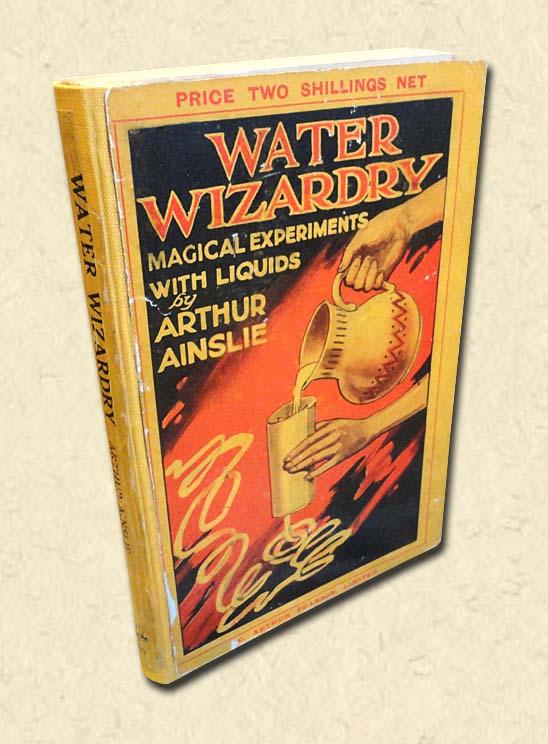
Ainslie, Arthur
Water Wizardry Magical Experiments with Liquids
Arthur Pearson, London, 1922.
Octavo; hardcover; 124pp., monochrome illustrations. Minor edgewear to boards; some rubbing. Repaired with new spine retaining original titling. Very good. Arthur Ainslie was a British magician, born Arthur Wellesley Odell Pain in 1870. He was a devotee of David Devant and an ardent writer of books on conjuring, possibly having ghost-written many important books on the subject. He is also known to have published under the pseudonym 'F.M. Archer'. In 1913 he presented his best-known trick wherein he constructed a doghouse on stage and produced a dog from it upon completion. He died in 1940. In this book, Ainslie outlines many notorious stage tricks which involve liquids of various kinds.
Click here to order

$75
216875
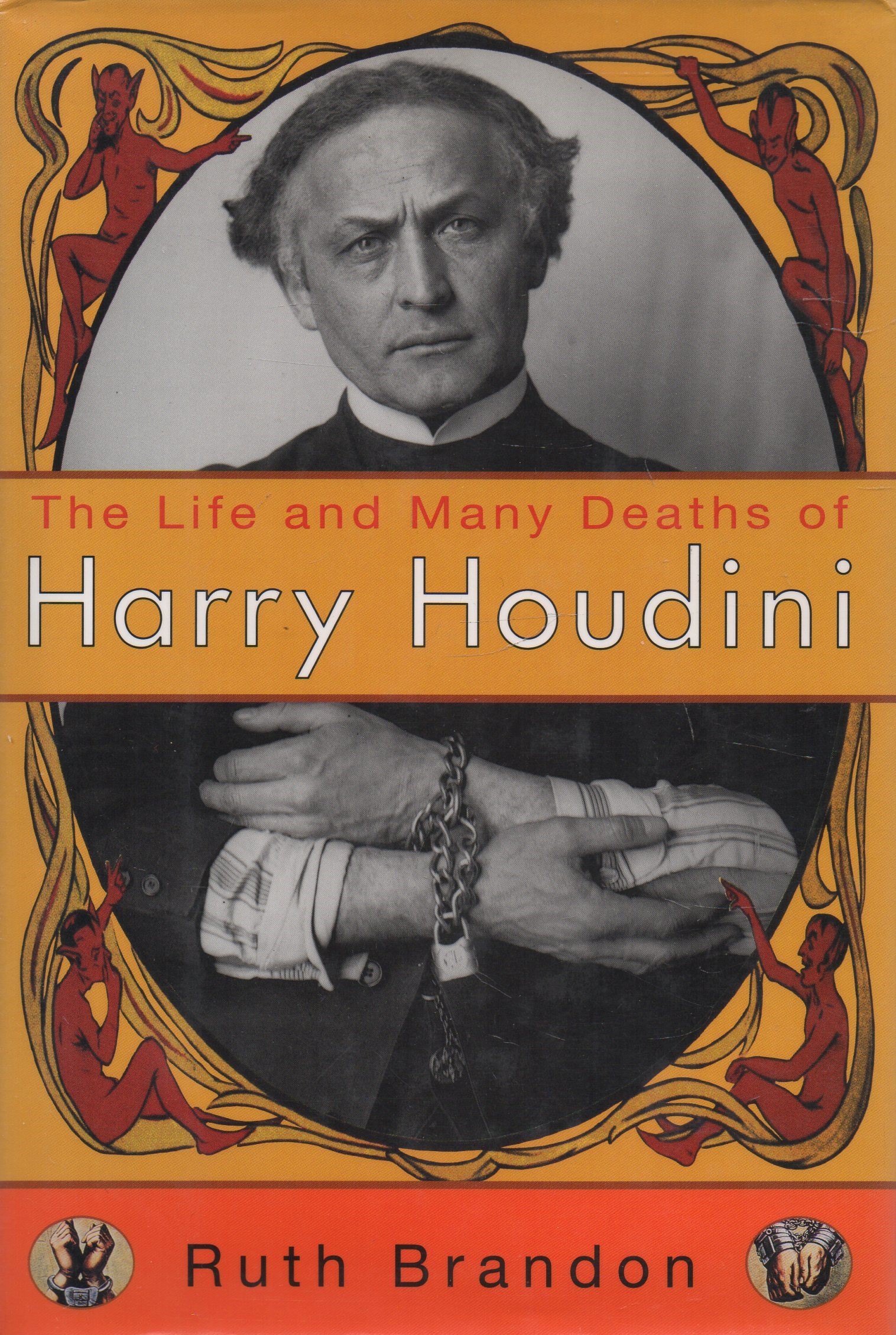
Brandon, Ruth
The Life and Many Deaths of Harry Houdini
Random House, 1993.
First edition. Octavo hardcover; quarter bound gold papered boards with red cloth spine and gilt spine titling; 355pp., b&w plates, untrimmed page edges. Faint spotting and toning to text block edges; mild edgewear to dustwrapper, now professionally protected by superior non-adhesive polypropylene film. Near fine. For many performers, stage life and real life are separate identities. For master illusionist Harry Houdini, the two were inextricably linked. In this widely acclaimed biography, Ruth Brandon shows how Houdini's obsession with his own mortality drove him to create death-defying stunts that not only captivated the public but also subdued his own raging psychological demons. As Brandon relates Houdini's methods of escape, she asks: What was he trying to escape from? Her exploration of the psychic landscape of one of the most enduringly famous performers of the twentieth century makes for utterly fascinating reading. Brandon reveals much that is new: how Houdini invented a phantom son; why he wrote long daily letters to his wife, Bess, who lived one floor below him; his combative relations with mediums and spiritualists, including Arthur Conan Doyle; and the first full description of his fabled death. This definitive biography allows readers to peer into Houdini's psyche and understand him more deeply than ever before.
Click here to order

$25
97133
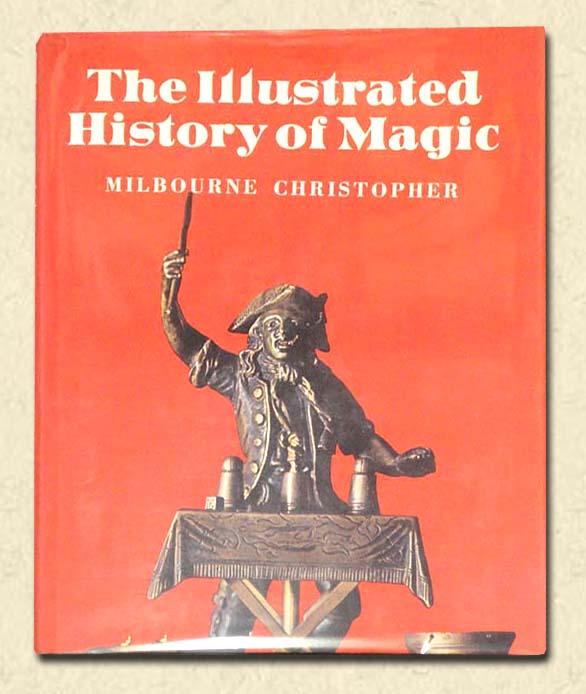
Christopher, Milbourne
The Illustrated History of Magic
Thomas Y. Crowell Company, New York NY, 1973.
First edition: quarto; hardcover, with gilt spine titles; 452pp., with a monochrome frontispiece, 8p. of colour plates and many monochrome illustrations. Moderate wear; slightly shaken; a bump to the spine heel; some sunning to the board edges; text block edges spotted; some minor marks to the rear endpapers. Dustwrapper is mildly edgeworn; now professionally protected by superior non-adhesive polypropylene film. Very good. Set off on a magical history tour with Milbourne Christopher's classic Illustrated History of Magic. Follow the fascinating stories of the world's greatest conjurers, from sorcerer-priests in ancient Egypt, The Great Herrmann, Harry Kellar, Chung Ling Soo, Houdini, to modern miracle workers like David Copperfield, Siegfreid and Roy, and David Blaine. Filled with fantastic illustrations, poster art, photographs and illusion diagrams, this book is a feast for anyone interested in the conjuring arts.
Click here to order

$50
82213
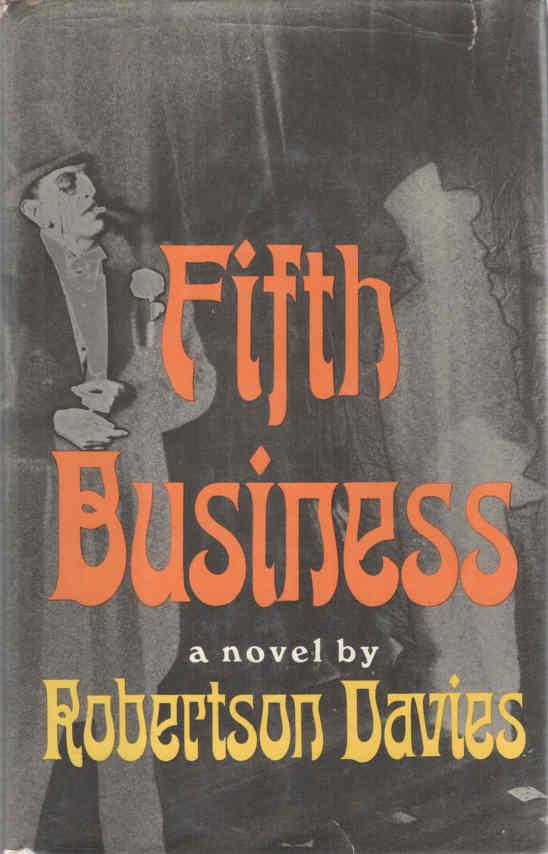
Davies, Robertson
Fifth Business
The Viking Press Inc., New York, NY, USA, 1970.
First edition: octavo; hardcover, quarter-bound in papered boards; 308pp., untrimmed, top edge dyed yellow. Boards somewhat mottled and faded in spots; spotting to text block edges. Dustwrapper with rubbing especially to rear panel; edgewear with a few small tears and chips; now professionally protected by superior non-adhesive polypropylene film. Very good. At one level a drily-indignant letter to the headmaster of the Boys' College at which he has worked for 45 years, the memoir of Dunstan Ramsay is actually a cunningly-designed conjurer's trick, opening up into a majestic spectacle, and revealing the writer's life as having been a cleverly-played sleight-of-hand ever since his return from the bloody fields of Passchendaele. Fifth Business is a magic trick, written with a conjurer's subtle touch, about a disillusioned man obsessed by magic and miracles, and it will amaze the reader with its grand finale.
Click here to order

$35
82214
Davies, Robertson
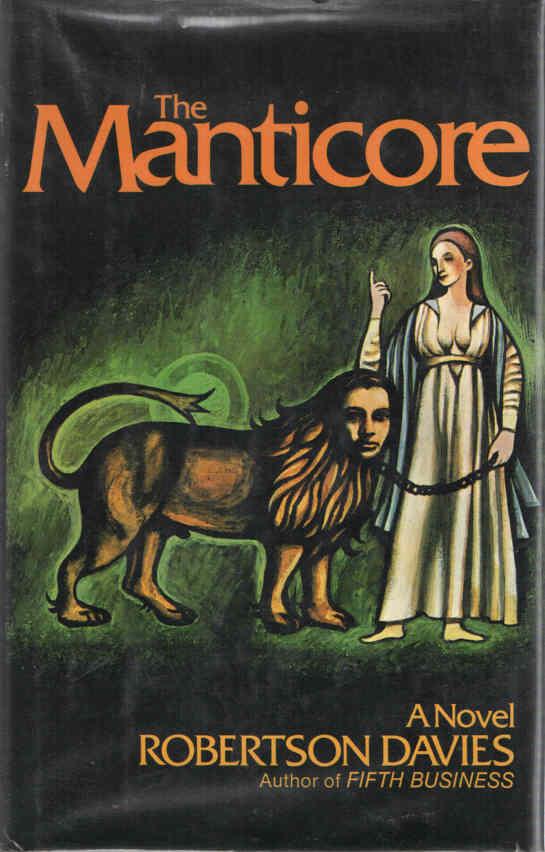
The Manticore
The Viking Press Inc., New York, NY, USA, 1972.
First US edition: octavo; hardcover, quarter-bound in papered boards; 310pp., untrimmed, top edge dyed green. Lightly toned text block edges. Illustrated dustwrapper with minor wear; now professionally protected by superior non-adhesive film with white paper backing. Very good to near fine. Following on from the first instalment, the magical Fifth Business, The Manticore follows the doings of Dunstan Ramsay's son, top-flight criminal lawyer David Staunton, as he turns to Jungian analysis in an attempt to understand the dead father who, to him, was more of a stranger. Drawn into the psychoanalytical magic spell are the uninhibited Leisl and the enigmatic stage magician Eisengrim, who each have their parts to play in helping Staunton understand his cryptical father... and himself.
Click here to order

$35
82215
Davies, Robertson
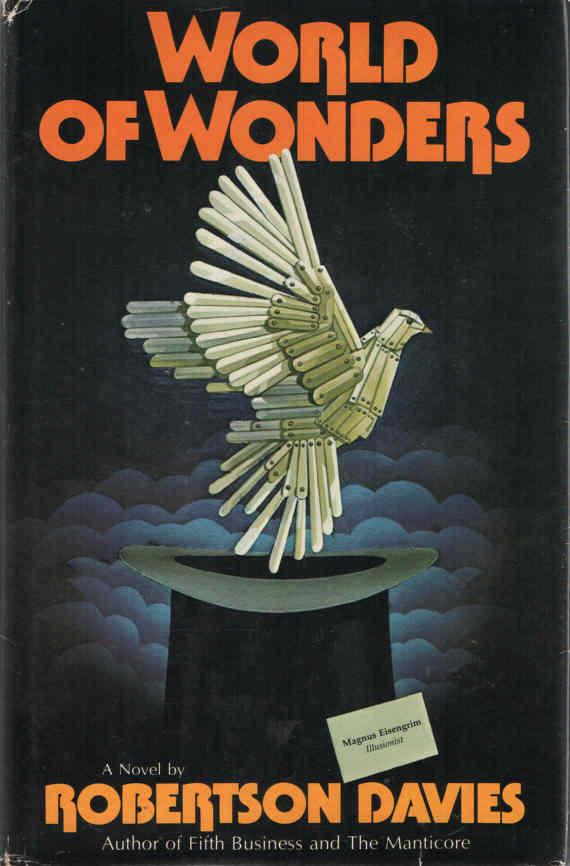
World of Wonders
The Macmillan Company of Canada, Toronto, Canada, 1975.
First Canadian edition: octavo; hardcover, with gilt spine titling; 358pp. Previous owner's ink inscription to the front pastedown; light wear to board bottom edges and corners; faint spotting to text block edges. Illustrated dustwrapper with some creasing and scrapes to edges especially to the spine extremities and flap turns; long tear along the rear flap turn; now professionally protected by superior non-adhesive polypropylene film. Very good. This is the third book in the trilogy which began with the mesmerising Fifth Business, but it stands on its own without the aid of the previous two instalments. This strand of the narrative is taken up by Magnus Eisengrim, abducted as a youth by a conjurer in a travelling fair and transformed into a master stage magician due to a chance meeting with - and striking resemblance to - London theatre manager Sir John Tresize. In relating his experiences in the tawdry sleaze of the travelling carnival - bunking alongside such luminaries as Molza the Human Salamander and Rango The Missing Link (a monkey) - he reveals at last the mysterious secret which drew him into strange partnership with Dunstan Ramsay (of Fifth Business) and Leisl Vitzliputzli (from The Manticore). Magical stuff!
Click here to order

$30
9075
Dawes, Edwin
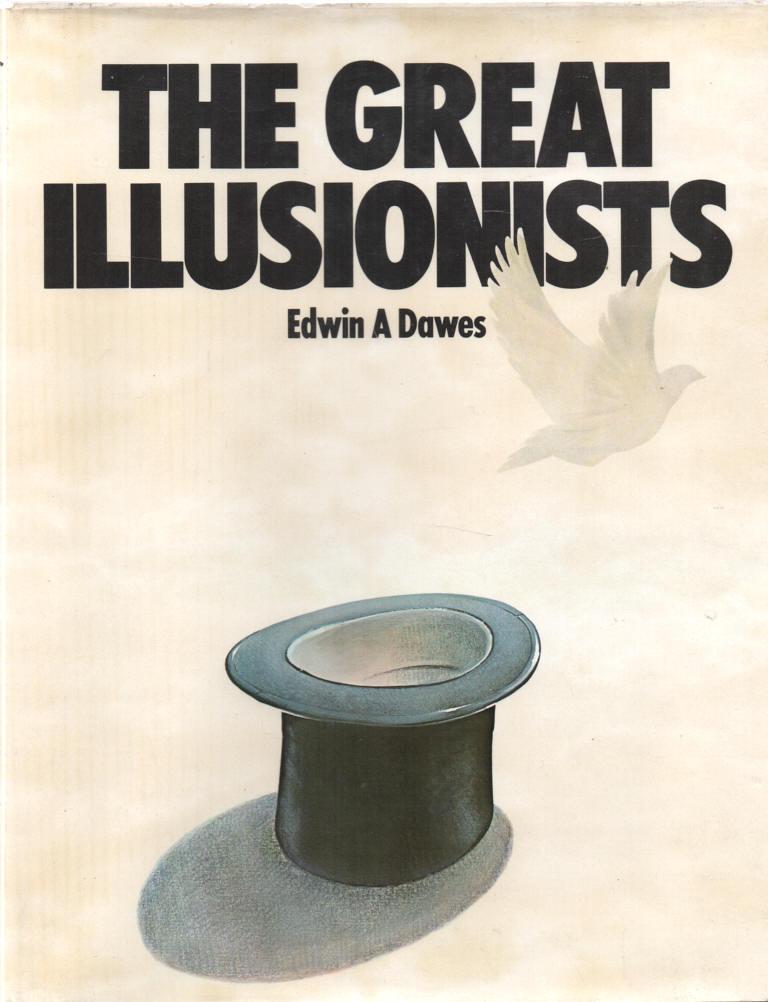
The Great Illusionists
Chartwell Books Inc., Secaucus NJ, 1979.
Quarto; hardcover, with gilt spine titles; 216pp., with many monochrome illustrations. Mild wear; boards slightly bowed; some spots and toning to the text block edges. Dustwrapper lightly rubbed with mild edgewear; now backed by archival-quality white paper and professionally protected by superior non-adhesive polypropylene film. Very good. Most of us respond with thrill to feats of the impossible. Whether the tricks are small, as when four kings are found in the middle of the pack, or large as when an attractive assistant floats across the stage, the excitement is the same. It is difficult to pin down the reason. We know, after all, that the magician doesn't have special powers... This book about magic and magicians gives us a look behind the mirrors to the ways people have been baffled by stage magic for centuries and takes us into the lives of magicians from the earliest times to the present.
Click here to order

$22
97208
[The International Brotherhood of Magicians - Alvin Richard Plough, ed.]
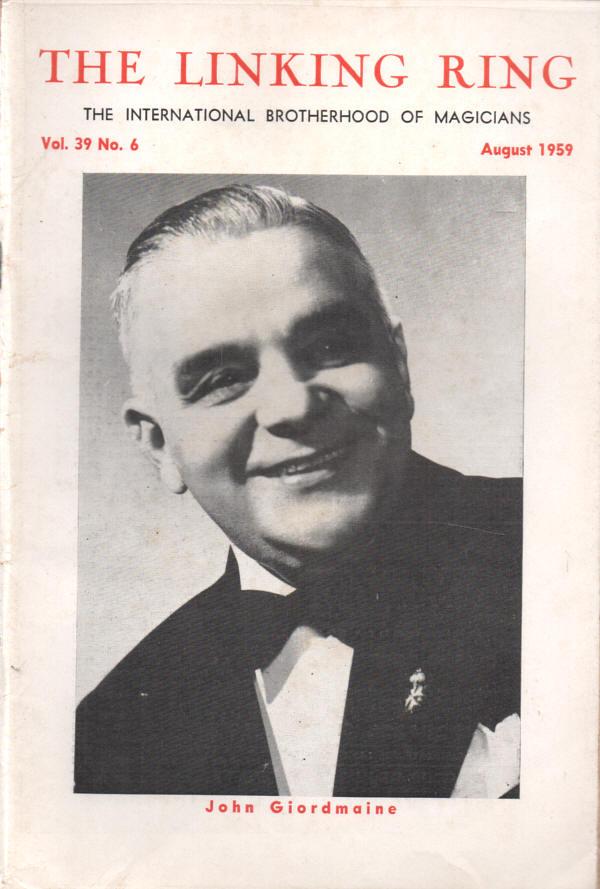
The Linking Ring - Vol.39 - No.6, August 1959 Official Publication of International Brotherhood of Magicians
The International Brotherhood of Magicians, Kenton OH, 1959.
Octavo; stapled paperback; 128pp., with many monochrome illustrations. Moderate wear; covers rubbed; light toning to the pages. Good. Along with its usual run of glorious advertising, this issue of The Linking Ring contains an article by Milbourne Christopher - well-known author on the history of magic - a report on a Canadian "parade", and discussions about injecting a spirit of creativity into a stage routine. The cover of this issue is graced by the smiling face of magician John Giordmaine. Many great routines are revealed inside and the magazine is now protected by a Mylar sleeve.
Click here to order

$20
97210
[The International Brotherhood of Magicians - Alvin Richard Plough, ed.]
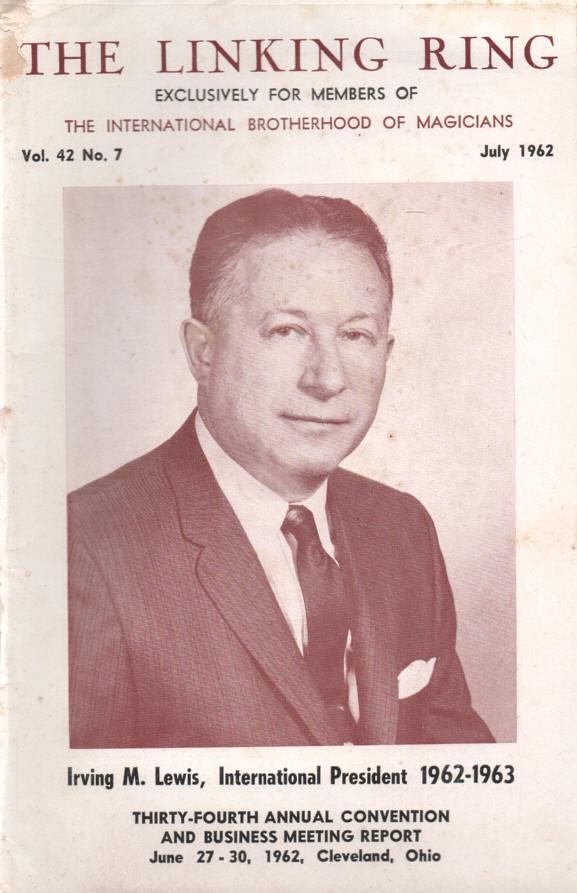
The Linking Ring - Vol.42 - No.7, July 1962 Official Publication of International Brotherhood of Magicians
The International Brotherhood of Magicians, Kenton OH, 1962.
Octavo; stapled paperback; 116pp., with many monochrome illustrations. Moderate wear; covers starting, rubbed and insect damaged; light toning to the pages. Good. This issue of The Linking Ring - along with usual run of great adverts for all kinds of magical gadgets - contains articles on Mentalism, "loads" and "steals" and the power of misdirection. On the cover of this issue is a picture of Irving M. Lewis, the IBM president for 1962-63. Many great routines are revealed inside and the magazine is now protected by a Mylar sleeve.
Click here to order

$17
97211
[The International Brotherhood of Magicians - Alvin Richard Plough, ed.]
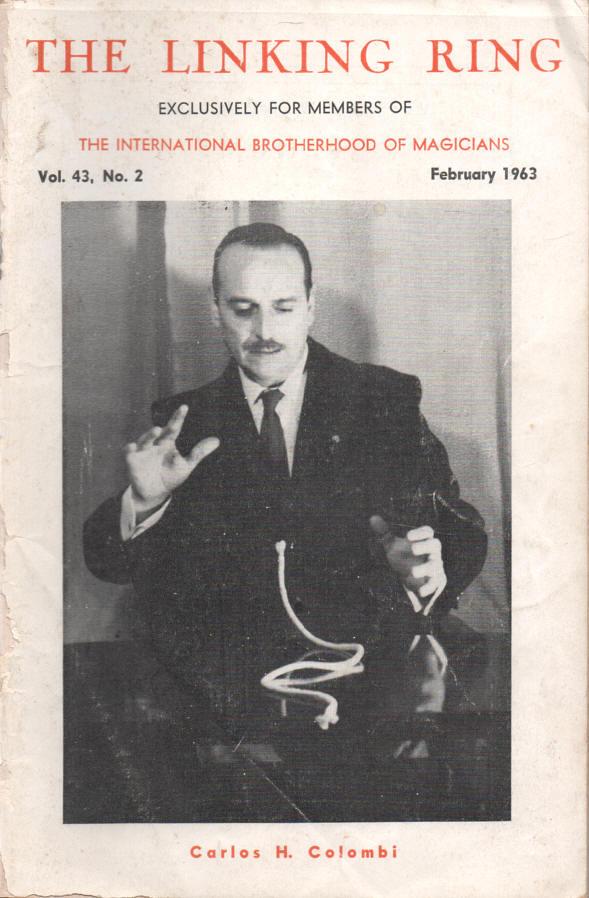
The Linking Ring - Vol.43 - No.2, February 1963 Official Publication of International Brotherhood of Magicians
The International Brotherhood of Magicians, Kenton OH, 1963.
Octavo; stapled paperback; 124pp., with many monochrome illustrations. Moderate wear; front covers almost detached; covers rubbed and insect damaged; light toning to the pages; some dog-eared pages; underlining in ink throughout and some ink doodles to the back cover. Good. This issue of The Linking Ring contains the usual run of advertising and letters from readers, as well as articles on the art of stage magic, the power of "patter" and an overview of Orientalist influences in the field. On the cover of this issue Carlos H. Colombi causes a piece of rope to magically rise into the air. Many great routines are revealed inside and the magazine is now protected by a Mylar sleeve.
Click here to order

$17
97212
[The International Brotherhood of Magicians - Alvin Richard Plough, ed.]
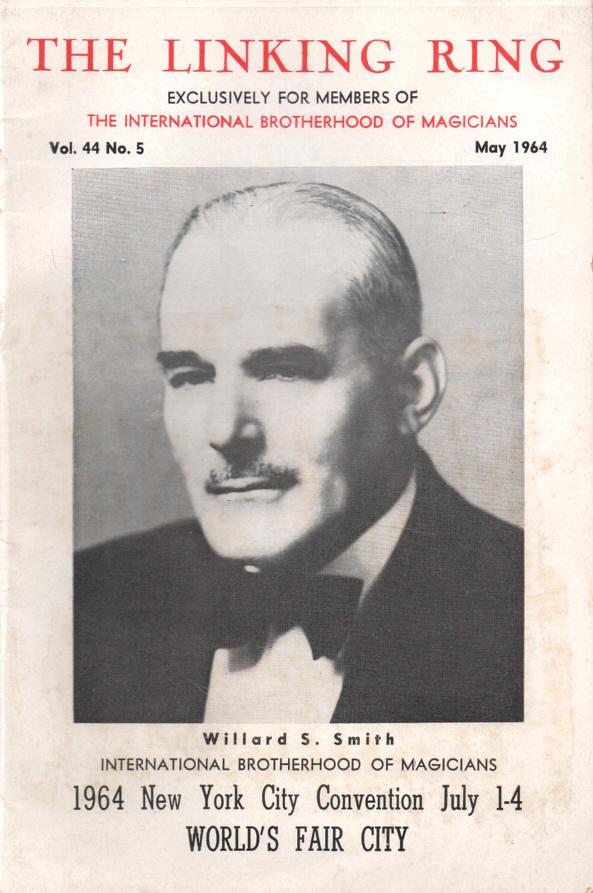
The Linking Ring - Vol.44 - No.5, May 1964 Official Publication of International Brotherhood of Magicians
The International Brotherhood of Magicians, Kenton OH, 1964.
Octavo; stapled paperback; 132pp., with many monochrome illustrations. Moderate wear; a tear along the spine to the top staple; covers rubbed; light toning to the pages. Good. Among all of the ads and letters, this issue contains a discussion of the future of the magic trade, whether stage magicians should consider themselves as something other than "entertainers", as well as an article about a young magician's early attempt to "bust" a spiritualist meeting. A very dapper Willard S. Smith graces the cover of this issue. Many great routines are revealed inside and the magazine is now protected by a Mylar sleeve.
Click here to order

$17
97213
[The International Brotherhood of Magicians - Howard Bamman, ed.]
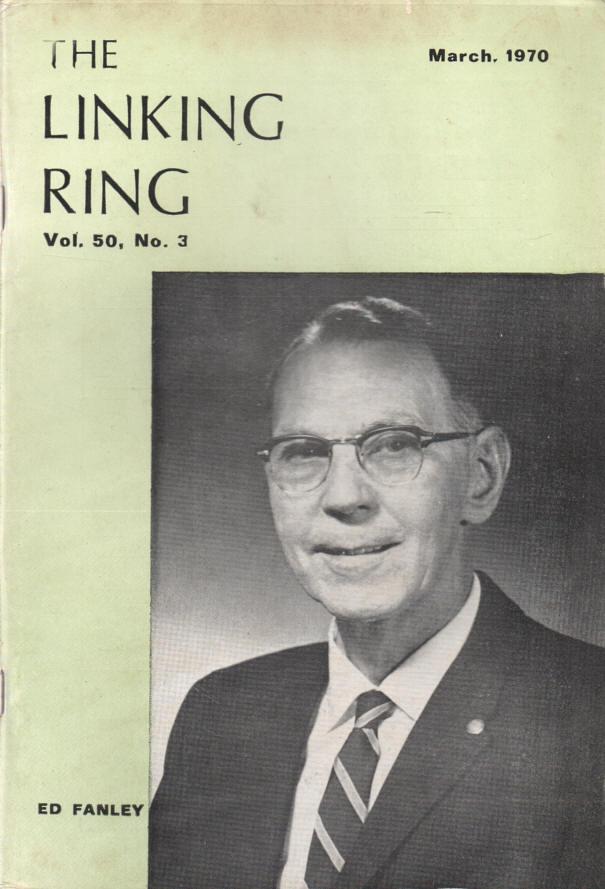
The Linking Ring - Vol.50 - No.3, March 1970 Official Publication of the International Brotherhood of Magicians
The International Brotherhood of Magicians, Palatine IL, 1970.
Octavo; stapled paperback; 148pp., with many monochrome illustrations. Moderate wear; covers rubbed; light toning to the pages; some underlining in ink. Good. With adverts and letters galore, this issue contains a discussion of the life of Robert-Houdin (from whom Houdini took his name) along with articles about legerdemain and mentalism. Magician Ed Fanley appears on the cover of this issue. Many great routines are revealed inside and the magazine is now protected by a Mylar sleeve.
Click here to order

$20
97214
[The International Brotherhood of Magicians - Howard Bamman, ed.]
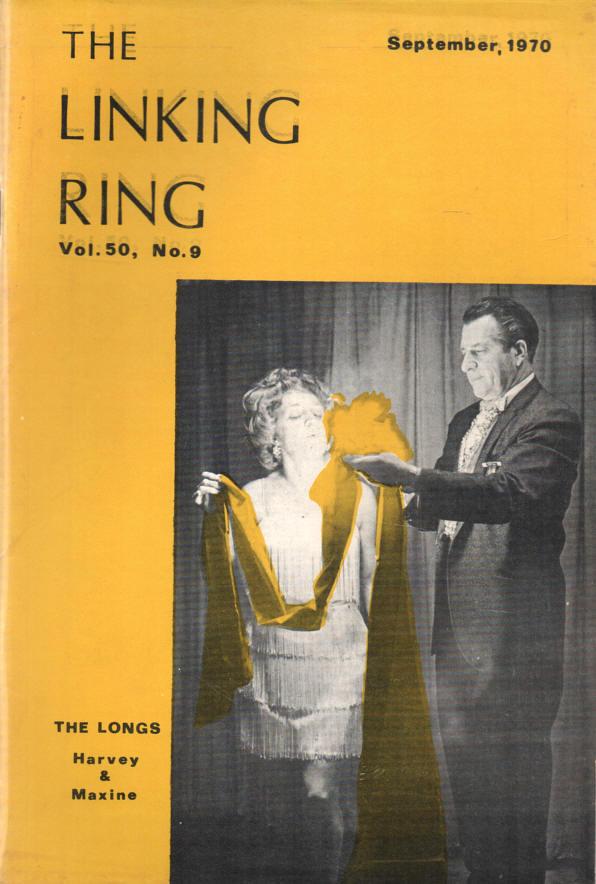
The Linking Ring - Vol.50 - No.9, September 1970 Official Publication of the International Brotherhood of Magicians
The International Brotherhood of Magicians, Palatine IL, 1970.
Octavo; stapled paperback; 132pp., with many monochrome illustrations. Mild wear; covers rubbed; light toning to the pages. Good. Harvey and Maxine Long grace the cover of this issue, caught mid-routine in a fiery act. The usual ads and letters appear within, along with articles about making your stage act commercially viable and some instructions on how to perform some intriguing puzzles. Many great routines are revealed inside and the magazine is now protected by a Mylar sleeve.
Click here to order

$20
97204
[The International Brotherhood of Magicians - W.W. Durbin, ed.]
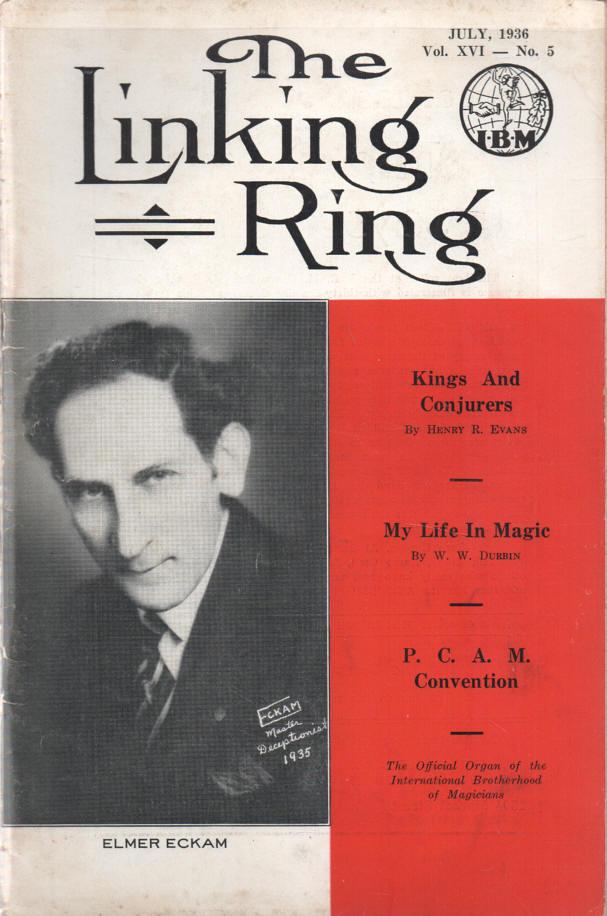
The Linking Ring - Vol.16 - No.5, July 1936 The Official Organ of the International Brotherhood of Magicians
The International Brotherhood of Magicians, Kenton OH, 1936
Octavo; stapled paperback; 74pp., with many monochrome illustrations. Moderate wear; front cover starting; covers rubbed; light foxing to the pages. Good. In this early edition of The Linking Ring, Henry Ridgley Evans discusses the past magicians who entertained the rulers of Europe while editor W.W. Dubbin discusses his life in the magic trade. All this, while the "Master Deceptionist" Elmer Eckham broods moodily on the front cover. The magazine is now protected by a Mylar sleeve.
Click here to order

$17
99522
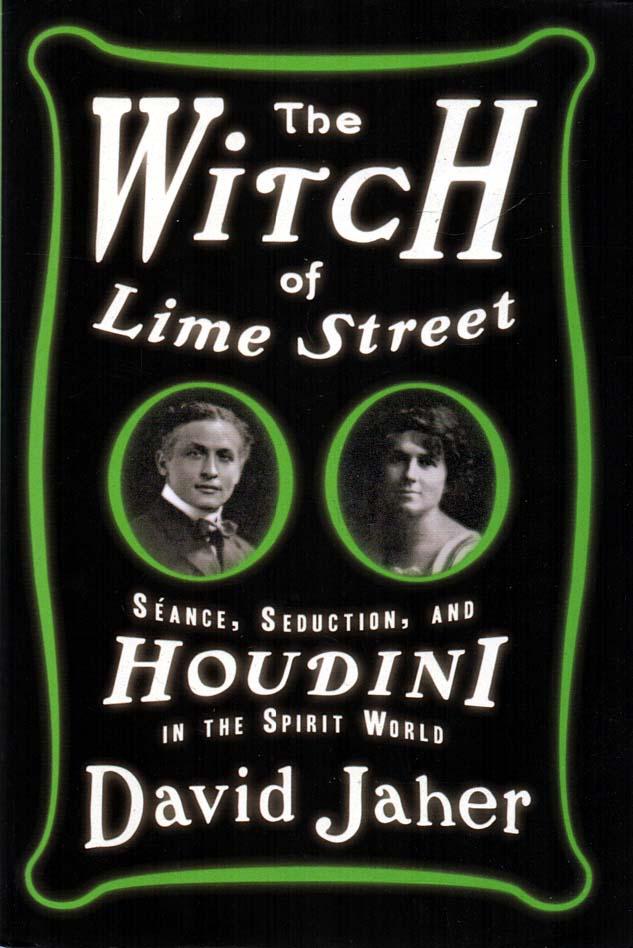
Jaher, David
The Witch of Lime Street Seance, Seduction and Houdini in the Spirit World
Crown Publishers, New York NY, 2015.
Octavo; hardcover, 436pp., monochrome illustrations. Dustwrapper. New, remainder. "Houdini was considered the greatest escape artist of the early 20th century, but by the 1920s, he turned his energies to unmasking spiritist frauds who claimed to have contact with the dead. Set against a backdrop of Jazz Age excess and anxiety, Jaher, in his first book, tells the story of Houdini's epic confrontation with a spiritist whose popularity rivaled his own. World War I and the Spanish influenza laid waste to a generation of young men in Europe and left the world 'teetering on the brink of a new dark age.' Observers like Sir Arthur Conan Doyle, who eventually became an ardent advocate of spiritualism (and friendly nemesis to Houdini), believed that the loss of so many loved ones would turn bereaved families seeking comfort 'toward spirit communion.' While seances became all the rage on both sides of the Atlantic and Conan Doyle lectured on the 'New Revelation,' reputable scientists began to explore the paranormal to determine the true nature of psychic phenomena. One particular group associated with Scientific American magazine put together a contest that would award $5,000 to anyone able to successfully prove his or her abilities. Among the judges was Houdini, whose career as a magician made him a formidable spiritist debunker. All but one medium tested by this group - the genteel Crandon - were conclusively demonstrated to be frauds. Through a combination of feminine seduction and illusionist skill that even Houdini admired, Crandon became the one psychic to almost win the respect of the scientific community and outshine Houdini as an entertainer. Jaher's narrative style is as engaging as his character portraits are colourful. Together, they bring a bygone age and its defining spiritual obsessions roaring to life. Fascinating, sometimes thrilling, reading." - Kirkus
Click here to order

$23
72264
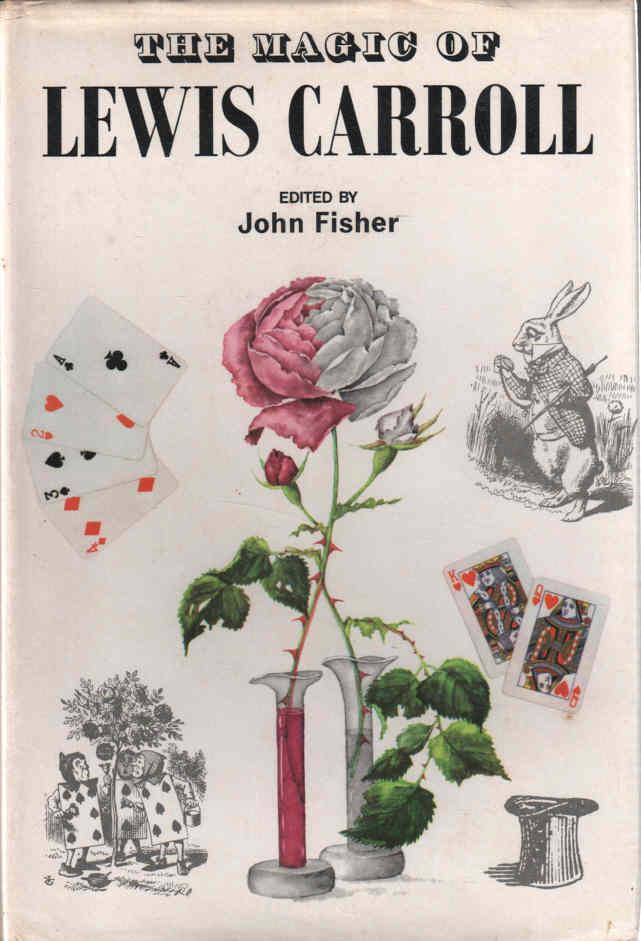
[Lewis Carroll] Fisher, John (ed.)
The Magic of Lewis Carroll
Thomas Nelson & Sons Ltd., London, 1973.
Octavo; hardcover, with gilt spine-titling; 288pp., with many monochrome illustrations and diagrams. Moisture damage to the lower board edges, not extending to the text block; board top edges sunned; previous owner's ink inscription to the half title; minor offset to the endpapers and scattered spotting to the preliminaries; text block edges toned with some spotting; light bumping to the corners and spine extremities. Price-clipped dustwrapper is lightly rubbed with some minor edgewear and spotting to the verso; now professionally protected by superior non-adhesive polypropylene film. Very good. Newspaper article 'The Curious Case of Lewis Carroll' by Morton N. Cohen laid in. There is a good story about Queen Victoria enjoying Alice's Adventures in Wonderland so much that she asked for a first edition of the author's next book. Two years later a beautifully wrapped package arrived, containing an inscribed copy of An Elementary Treatise on Determinants: With Their Application to Simultaneous Linear Equations and Algebraical Geometry. Sadly, the story isn't true. To his adoring readers he was Lewis Carroll, the sweet-natured writer who wandered through life with a head full of stories. To his long-suffering colleagues in Oxford he was the Rev Charles Dodgson, the prickly mathematician who walked around with a poker-straight back and a head full of algebra. The two were like strangers who merely happened to inhabit the same skin. This book is its own definition of the sense of wonder first evident in the activities of the boy wizard and later providing the protective cloak essential as refuge from an adult life that came to encompass loneliness and left-handedness, a stutter and seemingly unconquerable shyness. In amassing for this purpose as comprehensive a collection of Carroll's original games and puzzles as possible including various magic tricks and gambits, which, while not originated by himself, would certainly have been familiar and therefore of some influence on him, manifestations of that same basic desire to fascinate and intrigue, whether his audience be young friend or high-table colleague. In 1885, Carroll's diary entry admits that 'never before have I had so many literary projects on hand at once'. He then proceeds 'for curiosity' to list fifteen separate projects from mathematical treatises with titles like Supplement to Euclid and Modern Rivals and Plain Facts for Circle-Squarers to a projected bowdlerised edition of Shakespeare for young girls to 'A Collection of Games and Puzzles of my devising, with fairy pictures by Miss E G Thomson. This might also contain my "Memoria Technica" for dates, etc., my "cipher-writing", scheme for Letter-registration, etc, etc.' Editor John Fisher was himself a member of the International Brotherhood of Magicians and has previously published his own Magic Book.
Click here to order

$30
97136
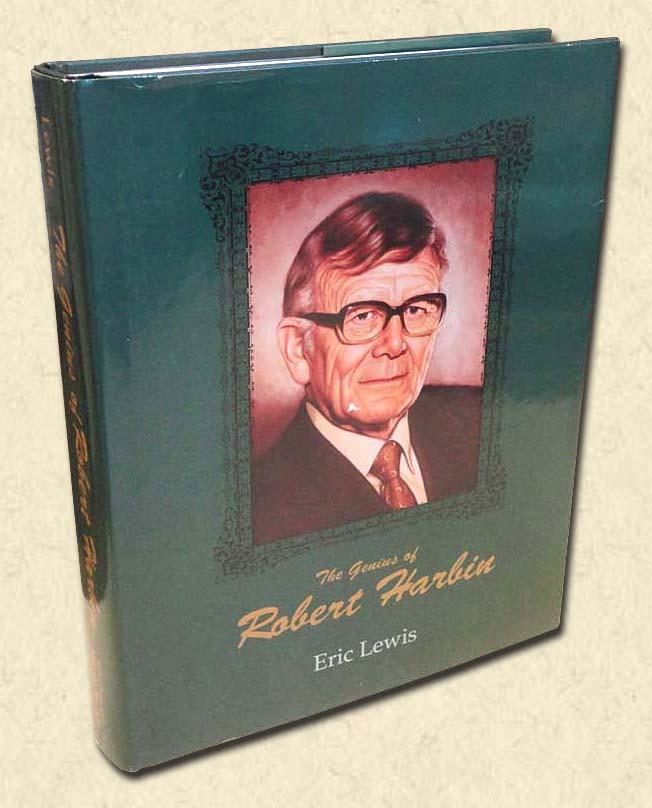
Lewis, Eric (Mike Caveney, ed.)
The Genius of Robert Harbin A Personal Biography
Mike Caveney's Magic Words, Pasadena CA, 1997.
First edition: quarto; hardcover, with gilt spine and upper board titles; 358pp., with a monochrome portrait frontispiece and many monochrome illustrations and diagrams. Minor wear. Dustwrapper very lightly edgeworn with a small surface tear to the front panel; now professionally protected by superior non-adhesive polypropylene film. Near fine. Robert Harbin is a name that towers over the world of magic. His original stage illusions are familiar, even to laymen, in all parts of the world. His incredible output of close-up, cabaret and stage magic continued unabated for over forty years. Today, Robert Harbin is recognized as a rare genius of 20th century magic. As a writer, artist and confidant of the legendary Robert Harbin, author Eric Lewis has produced a fascinating, behind the scenes look at the public, as well as private life of his friend. 'The Genius of Robert Harbin' includes detailed explanations for sixty-six Harbin effects, including a number of previously unpublished illusions.
Click here to order

$85
66186
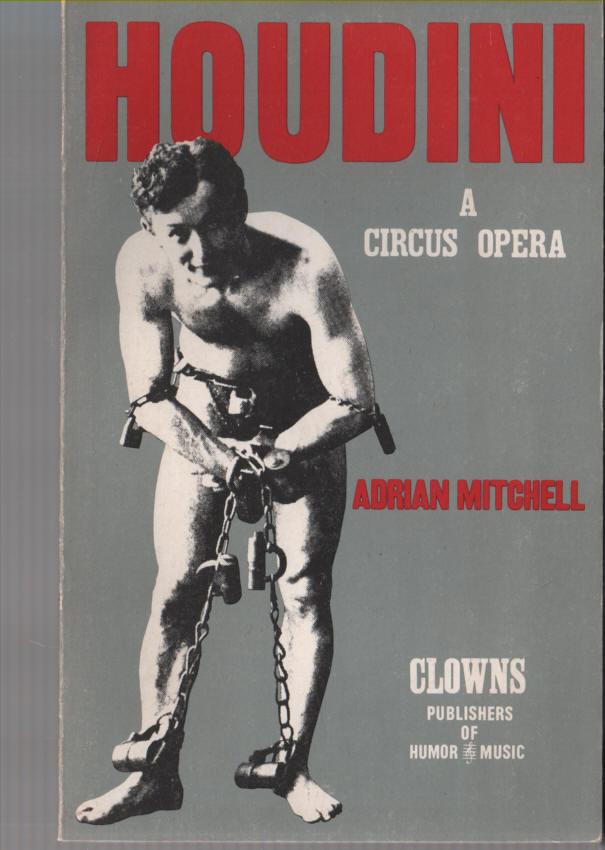
Mitchell, Adrian
Houdini A Circus Opera
Clowns, Amsterdam The Netherlands, nd. (c.1976).
Octavo; paperback; unpaginated, with many monochrome illustrations. Mild wear; covers a little rubbed. Near fine.
Click here to order

$20
97135
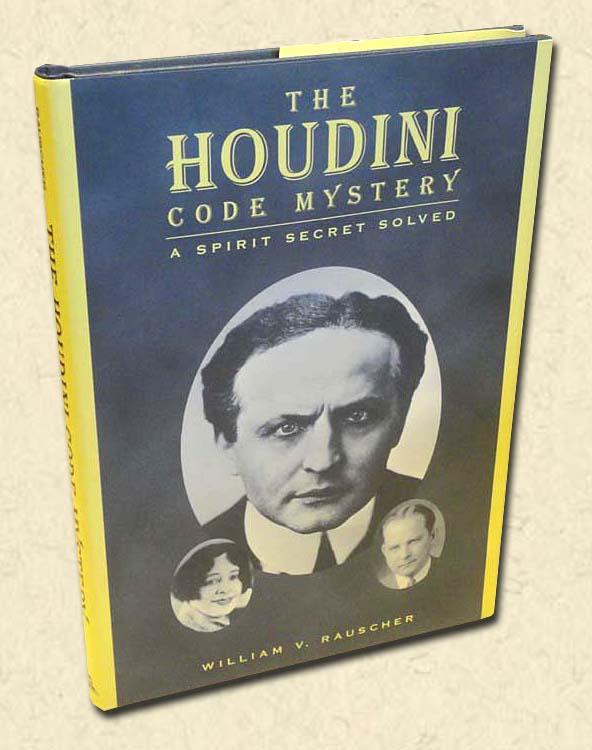
Rauscher, William V.
The Houdini Code Mystery A Spirit Secret Solved; Magical Pro-Files series, number 9
Mike Caveney's Magic Words, Pasadena CA, 2000.
First edition: octavo; hardcover, with gilt spine and upper board titles and decorated endpapers; 192pp., with a tipped-in colour frontispiece, a monochrome portrait frontispiece and many monochrome illustrations and diagrams. Minor wear. Dustwrapper very lightly edgeworn (now professionally protected by superior non-adhesive polypropylene film). Near fine. This book concerns the drama and mystery surrounding a code left by Houdini and supposedly known only by him and his wife Bess. He promised that after his death, if possible, he would communicate from beyond the grave. His wife would then affirm the communication if the prearranged words were correct in respect to the code. The code was used by the Houdini's in the early days of their act. Although the story of the code along with Houdini and Bess has been portrayed in films, written of in books and debated by magicians and researchers for years since Houdini's death in 1926, Rauscher is the only one to reveal the answer and solve the riddle. The author adds to this puzzling array of many characters his first hand knowledge of the famous medium, Arthur Ford, who was credited with receiving the message from Houdini and affirmed in a sworn document by Mrs. Houdini. Rauscher's friendship with Ford, his work on Ford's biography, 'The Man Who Talked With The Dead', places him in a unique position to finally reveal the truth behind one of the 20th century's greatest mysteries... Do the Spirits Return? In addition to the Houdini Code, Rauscher presents an in depth overview of the personality of Houdini and how he became an American icon. He has painted a unique and perceptive word portrait of Houdini quoting numerous great magicians of his era who speak candidly of the master escape artist. The book is a kaleidoscope of unusual and colourful characters. No. 684 of only 1,000 copies.
Click here to order

$120
97130
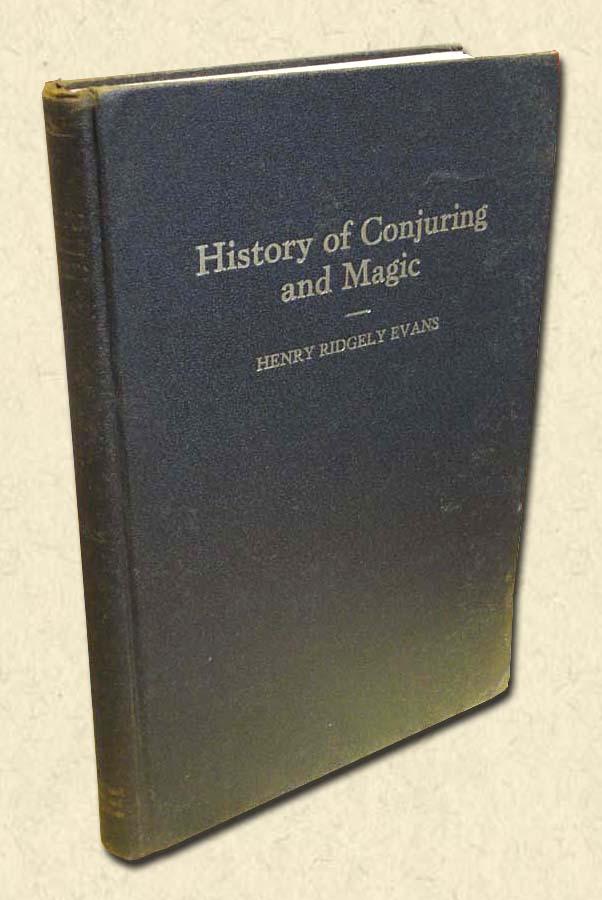
Ridgley Evans, Henry
History of Conjuring and Magic
International Brotherhood of Magicians, Kenton OH, 1928.
First edition: octavo; hardcover, with gilt spine and upper board titles; 235pp., with a colour frontispiece and many diagrams and half-tone illustrations. Moderate wear; shaken; softening to the spine extremities and corners bumped; boards rubbed and gilt worn from the spine; light dusting to the text block top edge; tape remnants and surface tears to the pastedowns. Lacks dustwrapper. Very good. Laid in: a portrait of Harry Houdini from a printed article in a Mylar envelope. Henry Ridgley Evans was an historian of conjuration. Not a performer of any great standing himself, he was on familiar terms with many of the great stage magicians of his day and helped many of them in the production of stage equipment and illusion design. He is known to have had a falling-out with Houdini after a misunderstanding as to whether this current volume on the history of magic would be a co-operative effort, or one in which Houdini merely lent some insights; the book came out and Houdini was not credited, hence the cooling of relations between them. No wonder then that this copy has a publicity shot of Houdini tucked in the back - perhaps an attempt at making amends?
Click here to order

$150
97131
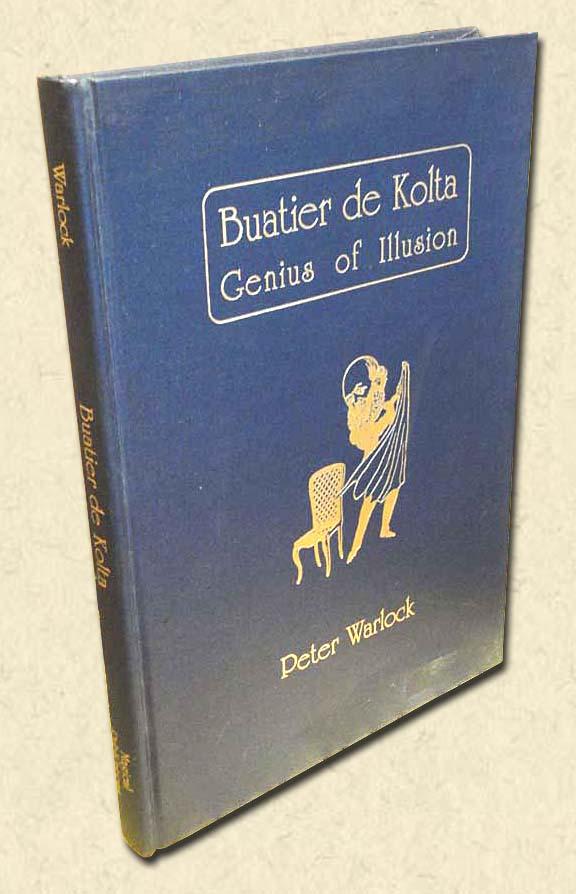
Warlock, Peter (Mike Caveney, ed.)
Buatier de Kolta - limited edition Genius of Illusion; Magical Pro-Files series, number 5
Magical Publications, Pasadena CA, 1993.
First edition: octavo; hardcover, with gilt spine and upper board titles and decorations, and decorated endpapers; 217pp., with a tipped-in colour frontispiece, a monochrome portrait frontispiece and many diagrams and half-tone illustrations. Moderate wear; cocked; softening to the spine heel; some rubbing to the upper board. No dustwrapper. Very good. De Kolta was a contemporary of fellow French magician Jean Eugene Robert-Houdin. Many of De Kolta's illusions, such as 'Multiplying Billiard Balls', 'The Expanding Cube' and 'The Vanishing Bird Cage', are performed by magicians today. 'Spring Flower' is also one of his creations. De Kolta is known for his 'De Kolta Chair' or 'Vanishing Lady' illusion. A woman seated in a chair, covered by a large cloth would appear to vanish before an audience (large cloth included). Present-day magician David Copperfield has adapted this illusion in his own performances. No. 763 of only 1,000 copies.
Click here to order

$400