-
71756
Alcock, Leslie
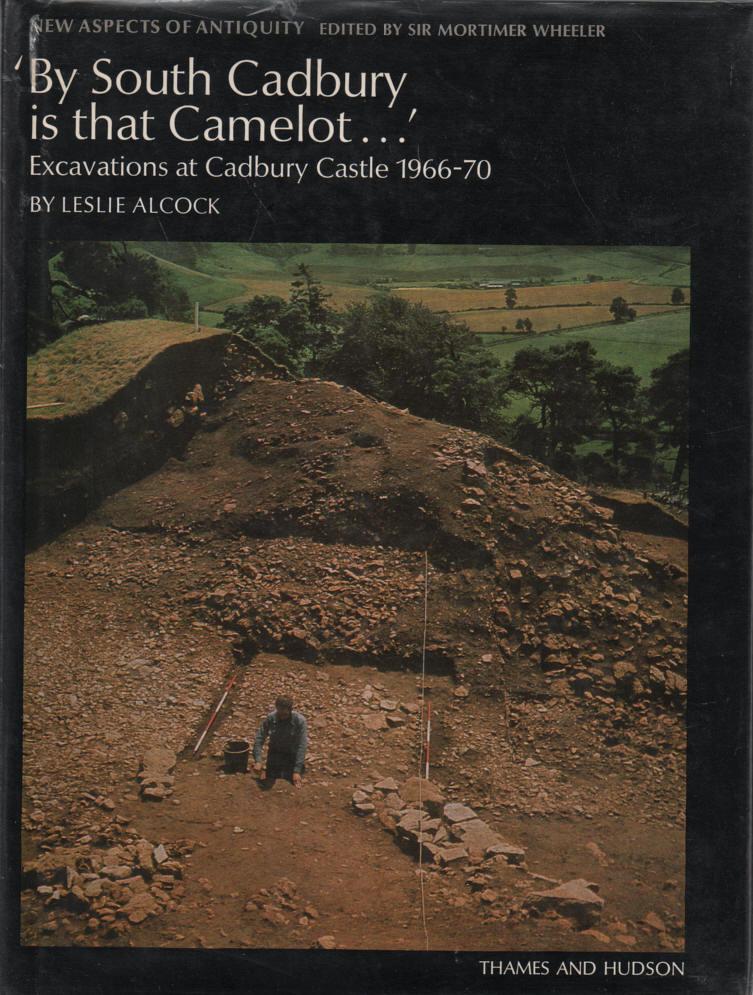
- 'By South Cadbury is that Camelot...' (New Aspects of Antiquity series) Excavations at Cadbury Castle 1966 - 70
Thames & Hudson, London, 1972.
Quarto; hardcover, with gilt spine-title and upper board decoration; 224pp., many mainly monochrome photographic illustrations, maps and line drawings. Front free endpaper removed; toned and spotted text block edges. Dustwrapper shows minor edgewear and chipping; now professionally protected by superior non-adhesive polypropylene film. Very good. 'Professor Leslie Alcock was a pioneer of 'Dark Age' archaeology and led the team which excavated Cadbury Castle in Somerset, the best known and most interesting of the reputed sites of King Arthur's Camelot. A hill fort beside the village of South Cadbury rising 500 ft above the surrounding Somerset plains, Cadbury Castle consists of four lines of bank-and- ditch defences surrounding a central plateau area of about 18 acres. Its association with the fabled court of King Arthur was made by two prominent Tudor antiquarians, John Leland and William Camden. In the 1530s Leland, who had been given a royal commission "to make a search after England's Antiquities", reported in his diary that: "At the very south end of the church of South-Cadbyri standeth Camallate, sometime a famous town or castle - The people can tell nothing there but that they have heard Arthur much resorted to Camalat." Antiquarian writers from Leland onwards routinely referred to Cadbury as Camelot. The highest part of the hill is known as Arthur's Palace, a name on record as early as 1586... large-scale excavations from 1966 to 1970 under Leslie Alcock's direction (took place). The results were spectacular... But by far the most exciting discovery was that the fort had been reoccupied and refortified in the late fifth or early sixth century, and remained occupied until some time after 580. On the high part of "Arthur's Palace", Alcock and his team discovered foundations of a timber hall, 63 ft by 34 ft, its walls defined by post-holes cut in the bedrock, possibly modelled on the villa complexes of later Roman Britain. At the south-west entry were the remains of a gatehouse consisting of a square wooden tower, approached by a cobbled road 10 ft wide, which would have passed through two sets of double doors on either side of the gatehouse. Most important of all was the discovery that the surrounding rampart had been massively rebuilt in Arthurian times, providing a defended site double the size of any other known fort of the period. On top of the earth at that level was a dry stone bank or wall 16 ft thick. Within the structure, sherds of pottery from the eastern Mediterranean, including fine red bowls and amphora, were also found from this period, indicating extensive trade links. There was nothing with Arthur's name on it, but what Alcock and his team found suggested that a leader with considerable resources at his command had taken possession of the vacant hill fort and refortified it on a colossal scale. At the centre he built at least one substantial building and probably several smaller ones, enough to house not only his family, but also an army of retainers, servants and horses. At the time he was excavating Cadbury, Alcock inclined to believe that Arthur was an historical figure, a view reflected in his Arthur's Britain, a lively and scholarly account of the available historical and archaeological evidence, published in 1971 and reprinted several times. In later life, though, he distanced himself from the book, having become convinced by historians that there was no good evidence that Arthur ever existed. "There are no historically acceptable accounts, so it's pretty futile to try and identify where Camelot may or may not have been," he admitted in 1999. However, he continued to maintain that, if Arthur had lived anywhere, Cadbury Castle was the most likely site.' - The Telegraph.
Click here to order
$28
|
|