-
86940
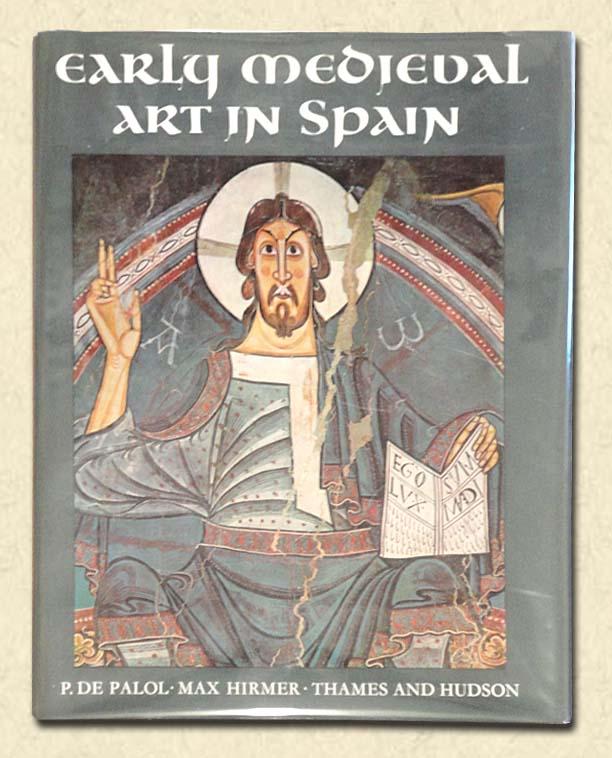
Palol, Pedro de & Max Hirmer (photos. Max Hirmer & trans. Alisa Jaffa)
- Early Medieval Art in Spain
Thames and Hudson, London, 1967.
Large quarto hardcover; turquoise cloth boards with gilt spine titling and centre board gilt publisher's insignia; 500pp., 54 tipped in colour plates, 256 monochrome plates and 158 text figures, maps and tables. Minor wear; discolouration where a bookplate has been removed from front pastedown; offsetting to endpapers, scattered spotting to half-title page; toned text block edges with black mark on lower edges; creasing and two small tears to side page edges of last page. Illustrated green dustwrapper with a few tiny chips at corners. Very good otherwise and professionally protected by superior non-adhesive polypropylene film. In Spanish art, as in Spanish history, there is no peace. Produced under pressures more extensive than those which have affected almost any other nation, it possessed from earliest times those qualities that have characterized it ever since: violence, single-mindedness and a sense of intense religious devotion - the values of a people fighting for its survival in a never-ending crusade. Yet, paradoxically, it was from Islam that many of the finest features of the emergent art of Spain were derived. The evolution of early medieval Spanish art was complex. The first phase was represented by the Visigoths, of whose work little survives but that little of absorbing interest, notably the jewelled crowns found at Guarrazar. Then came the Moors, swallowing the whole of the peninsula except the tiny northern kingdom of Asturias, where an amazingly developed culture flourished, reaching its climax in the tenth century. Meanwhile, in 'occupied' Spain, the Christian communities evolved perhaps the strangest style in medieval art: the Mozarabic, a fusion of the Visigothic and Muslim styles. Its masterpiece is the illuminated Commentary on the Apocalypse, by Beatus, illustrated here in six colour plates and others in black and white. In the ninth century the nation took its place in the mainstream of European culture, and the great pilgrimage church of Santiago de Compostela became one of the most venerated shrines in Christendom. During the twelfth century, to a far greater extent than is widely assumed, Spain occupied one of the most prominent and independent places in the pattern of European art. And Catalan Romanesque art is fully comparable with French Romanesque; a large number of examples remain, not only buildings but frescoes and manuscripts. This definitive survey of early medieval Spanish art is profusely illustrated with plans and diagrams. The magnificent series of plates covers a vast range of architecture, frescoes, illuminated manuscripts, sculpture, ivory carving and gold and silver work. There are detailed notes on the plates, and genealogical tables and maps. As a reference, this book is indispensable; as a collection of superb illustrations, irresistible.
Click here to order
$100
|
|