-
87066
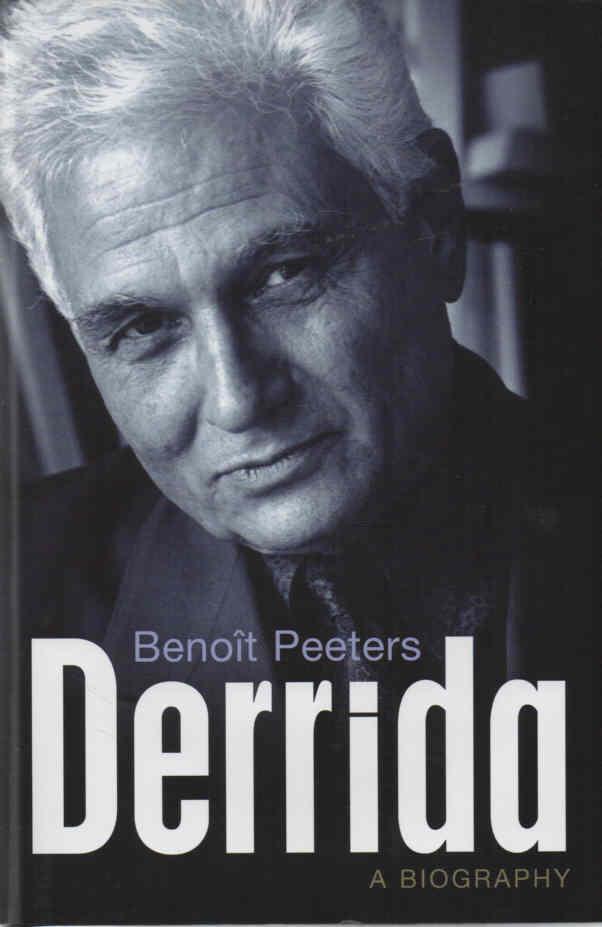
Peeters, Benoit (trans. Andrew Brown)
- Derrida: A Biography
Polity, Cambridge, 2013.
Octavo hardcover; black boards with white spine titling; 629pp., colour and monochrome plates. Minimal wear; near fine in like dustwrapper. In May 1992, the dons of Cambridge University filed into their parliament to vote on whether to award an honorary degree to the French philosopher Jacques Derrida, founder of so-called deconstruction. Despite a deftly managed smear campaign by the opposition, Derrida's supporters carried the day. It would be interesting to know how many of those who tried to block him in the name of rigorous scholarship had read a single book of his, or even a couple of articles. The truth is that they did not need to. The word was abroad that this purveyor of fashionable French gobbledegook was a charlatan and a nihilist, a man who believed that anything could mean anything and that there was nothing in the world but writing. He was a corrupter of youth who had to be stopped in his tracks. As a teenager, Derrida had fantasised with some of his friends about blowing up their school with some explosives they had acquired. There were those in Cambridge who thought he was planning to do the same to western civilisation. He did, however, have an unlikely sympathiser. When the Duke of Edinburgh, chancellor of Cambridge University, presented Derrida with his degree in the year in which Charles and Diana separated, he murmured to him that deconstruction had begun to affect his own family too. Deconstruction holds that nothing is ever entirely itself. There is a certain otherness lurking within every assured identity. It seizes on the out-of-place element in a system, and uses it to show how the system is never quite as stable as it imagines. There is something within any structure that is part of it but also escapes its logic. It comes as no surprise that the author of these ideas was a Sephardic Jew from colonial Algeria, half in and half out of French society. If his language was French, he could also speak the patois of working-class Arabs. He would later return to his home country as a conscript in the French army, a classic instance of divided identity... Benoit Peeters has ransacked the voluminous Derrida archives and interviewed scores of his friends and colleagues. The result is a marvellously compelling account, lucidly translated by Andrew Brown. The man who emerges from this portrait is an agonised soul with sudden outbreaks of gaiety, an astonishingly original thinker with more than a dash of vanity who nevertheless made himself fully available to the humblest student. In personal conversation he was that most admirable of intellectuals, one visibly relieved not to have to speak of intellectual matters. He was one of the latest in an honourable lineage of anti-philosophers - from Kierkegaard, Nietzsche and Marx to Freud, Adorno, Wittgenstein and Walter Benjamin - who could say what they had to say only by inventing a new style of writing and philosophising. Not all of Derrida's writing is to everyone's taste. He had an irritating habit of overusing the rhetorical question, which lends itself easily to parody: 'What is it, to speak? How can I even speak of this? Who is this 'I' who speaks of speaking?' Even so, the Cambridge backwoodsmen were wrong. Derrida, who died of cancer in 2004 urging his friends to affirm life, was no nihilist. Nor did he want to blow up western civilisation with a stick of conceptual dynamite. He simply wished to make us less arrogantly assured that when we speak of truth, love, identity and authority, we know exactly what we mean." - Terry Eagleton
Click here to order
$30
|
|